Our last leg of Safari in a Safari was to get to Jaipur wandering through national parks, reserves and bird sanctuaries. This one was the return leg, albeit even larger. The idea was to collect Safari (car) from Kanpur and come all the way to Mumbai. Of course, not missing the flora, fauna and the nature.
Dec 19, 2025
The safari technically began in Mumbai — not in a forest, not on a highway, but with a polite little message that wrecked all ambition: “Flight to Varanasi cancelled due to fog.” North India was wrapped in its annual winter smog-fog, the kind that doesn’t just reduce visibility but also humbles travellers with plans. Instead of walking along the Ganga, I walked between my desk and the kitchen; instead of scanning tree lines with binoculars, I scanned inbox threads that should not exist in late December. The half-packed backpack sat near the wall like a loyal dog denied its promised outing, and every few hours I refreshed flight updates as if atmospheric visibility could be improved through optimism alone.
By evening the irritation softened into reluctant amusement. We were heading toward Central India for open skies, forests and waterfalls — and the first reminder from nature was that you move when it allows you to move. The safari hadn’t started, but it had already developed character.
Day 1 — Varanasi: Back in Time
Dec 20, 2025
When I finally landed in Varanasi, the city did not feel like a destination — it felt like something we had entered. We walked to our hotel through lanes so narrow that dragging a suitcase felt like a social negotiation; scooters brushed past, cows stood with administrative authority, and overhead wires stitched the grey winter sky into a permanent ceiling. The first sight of the ghats — especially Dashashwamedh Ghat and the smouldering solemnity of Manikarnika Ghat — shifted the mood instantly. Smoke rose steadily, bells rang without coordination, priests moved with ritual muscle memory, and the Ganga flowed on with a calm that felt mildly indifferent to human urgency. We slipped through the crowd for the evening aarti, flames circling in synchronized arcs against the dark river, the chants rising and falling like breath.
In between divinity and chaos, we found small earthly anchors: a sharp masala-lemon tea that cut through the cold, a bowl of winter Malaiyo that dissolved before it could be properly understood, and a long queue at Kashi Vishwanath Temple that tested both patience and calf muscles. A brief stop at Kaal Bhairav Temple added a fiercer undertone to the day, and by the time we sat down for dinner at Monalisa Cafe, it felt as if we had lived through several centuries in a single afternoon.
Day 2 — Varanasi: Fog & ghats
Dec 21, 2025
Morning arrived wrapped in fog again, softening the sharp edges of the ghats as we walked from Dashashwamedh Ghat toward Assi Ghat. Boats hovered like unfinished thoughts on the river, priests appeared as silhouettes, and the entire stretch felt like we had quietly stepped into a long, lingering scene from Masaan — reflective, slightly melancholic, unhurried. The ghats in daylight are less dramatic than at aarti time, but more intimate; laundry dries beside shrines, chai simmers next to philosophical debates around Mukti, and life and death continue their parallel routines without announcement. Somewhere between wandering and observing, hunger took over and we made our way to Deenanath Chat Bhandar for tamatar chaat and palak chaat — both aggressively flavorful, unapologetically chaotic, very much in character with the city.
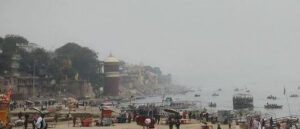
Later we stopped at Tulsi Manas Temple, calmer and more structured than the old-city shrines, before drifting into an evening boat ride where the Ganga turned metallic under fading light. Night brought the Mahindra Kabira Festival — music carried over water, audiences wrapped in shawls, and the strange comfort of sitting by an ancient river listening to poetry that refused to age. By the time we walked back through the lanes, the fog had thickened again, but Varanasi no longer felt overwhelming; it felt immersive.
Couldn’t resist adding “Bhor” for you to listen
Day 3 — The Long Wait to Kanpur
Dec 22, 2025
The plan was simple: catch the early morning train and roll into Kanpur before lunch. Indian Railways and Gangetic plains, however, had its own cinematic pacing in mind. The 6 AM departure quietly drifted to 12:30 PM, and we spent the morning in that uniquely Indian limbo of platform announcements, chai refills, and speculative optimism. Fog still lingered like a bureaucratic stamp that refused clearance. When the train finally moved, it felt less like punctual transport and more like negotiated permission.
We reached Kanpur late in the afternoon, mildly tired but warmly received at Shashwat’s home. If Varanasi had been spiritual austerity, Kanpur was caloric rehabilitation. We ate with purpose — as if forests ahead might not cooperate — stocking up on comfort and conversation. The safari paused here, not dramatically, but deliberately; a domestic intermission before the highways began pulling us southward.
Day 4 — Kanpur: The Calm Before the Highways
Dec 23, 2025
If the previous day was about delayed motion, this one was about deliberate stillness. Kanpur moved at a softer volume — winter sun filtering lazily (whatever it could muster) through balconies, neighborhood sounds replacing temple bells and train horns. We surrendered to the comfort of not having an agenda. A significant portion of the morning dissolved into binge-watching the YouTube channel Wonderda, which felt appropriately thematic for a trip that was steadily becoming one long wonder-documentary anyway.
Later, we stepped out to meet Shubham at Mithas, where conversations stretched comfortably across work, travel, and the kind of exaggerated future plans that only feel convincing over sweets and snacks. It was an ordinary day by design — no forts, no ghats, no wildlife sightings — just a gentle pause before the road trip properly ignited. By night, the bags were repacked with more intent than before. The foggy north had held us long enough; tomorrow, we would finally start driving toward clearer skies.
Day 5 — Orchha: Central India, here I come!
Dec 24, 2025
Somewhere barely an hour south of Kanpur, the fog simply surrendered. The grey curtain that had followed us for days lifted as if someone had adjusted the saturation settings of the entire landscape. Blue sky returned. The winter sun turned cooperative. By the time we reached Jhansi, the air felt crisp and newly minted. The imposing walls of Jhansi Fort stood under a clean sky, its museum rooms holding quiet echoes of rebellion and memory. It was the first moment of the trip that truly felt expansive — no smog, no narrow lanes, just open views and warm light on old stone.
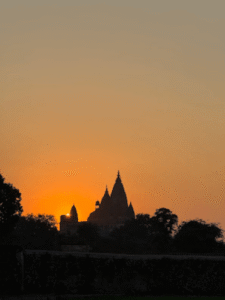
From there we drifted into the slower rhythm of Orchha, where the Betwa River curves lazily past cenotaphs and palaces that seem almost too picturesque to be real. Our riverside stay allowed the afternoon to stretch without urgency. We wandered through the sprawling courtyards of Orchha Fort for hours — climbing terraces, peering through arched windows, and pausing often to scan the riverbanks where birds skimmed the water’s surface. History and birding began forming their quiet alliance here. The evening light-and-sound show tried to dramatize Orchha’s past, but after Khajuraho (which still loomed ahead in memory), it felt slightly underwhelming. Still, as we walked back along the darkening river, the silhouettes of the chhatris against the sky made up for any theatrical shortcomings. The road trip had finally found its rhythm.
Day 6 — Khajuraho: Sculptures, Silence and Sudden Wildlife
Dec 25, 2025
Morning in Orchha dissolved gently into more riverside wandering before we steered toward Khajuraho, where sandstone has been narrating human imagination for nearly a millennium.
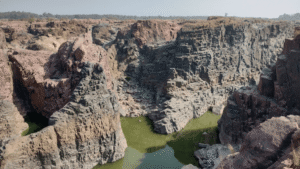
But the day refused to remain purely architectural. At Raneh Falls, the landscape shifted dramatically — volcanic rock canyons sliced deep and jagged, their colours ranging from rusty red to charcoal black. Nearby, within the bounds of Ken Gharial Sanctuary, we scanned the riverbanks and were rewarded with gharial basking in prehistoric stillness, mugger crocodile occupying their own territorial patches, and chital stepping lightly through scrub. A wild boar appeared briefly, unconcerned and efficient. At one point a large stork-like bird glided across the sky — impressive, unidentified, and immediately a topic of debate that would remain unresolved.
The temples of the Khajuraho Group of Monuments are often reduced to a single adjective in casual conversation, but standing before them is something else entirely — intricate panels unfolding like graphic novels in stone, celestial dancers frozen mid-spin, entire philosophies carved with surgical patience. We moved between the eastern and western complexes slowly, letting the scale and detail sink in rather than rushing through checklist photography. By the time we checked into MPT Kutni Resort that evening, temple carvings and reptilian silhouettes had merged in memory, and the safari had quietly expanded beyond its original brief.
Day 7 — Sal Forests, Falling Water and Borders That Meant Nothing
Dec 26, 2025
Morning at MPT Kutni was efficient — quick tea, a short scan of the trees, a pied kingfisher doing what they reliably do, sunbirds flickering through branches, lapwings screeching in the distance. Enough to confirm that the day had begun well. We wrapped up the southern temple complex in Khajuraho and pointed the car toward Panna, where the landscape gradually thickened into Sal forest.
Sal forests have a particular presence — tall, straight trunks rising with disciplined uniformity, their bark textured and slightly rugged, the dried leaves and the dust around generating a hazy backdrop. Unlike chaotic tropical forests, these feel structured, almost architectural, as if planted by intention. The undergrowth was relatively open in patches, large dry leaves carpeting the ground and crunching underfoot when we stepped out. The air carried that faint woody scent — clean, slightly resinous — and the road cut through in long, quiet stretches where human sound quickly dissolved. It was easy to imagine larger mammals watching invisibly from deeper inside.
At Pandav Falls we descended from the gate down to the base, each turn in the path amplifying the sound of water until the falls finally revealed themselves in a cool, echoing amphitheatre of rock. A brief attempt at Ajaigarh Fort ended in practical surrender — narrow approach roads and a two-hour climb that our schedule simply could not absorb.
Driving toward Chitrakoot, we crossed the Uttar Pradesh–Madhya Pradesh border so many times it began to feel ceremonial rather than official. Near dusk, two jackals stood on the roadside, alert and lean, before slipping back into scrub. At Ram Ghat the evening scene was modest and local — a calm stretch of water within the town, colorful boats ferrying families along short loops, some with decorative rabbits for children. No grand spectacle, just a small-town riverbank closing the day gently.
Day 8 — The Day the Sky Grew Larger
Dec 27, 2025
Morning in Chitrakoot began with the ropeway to Hanuman Dhara — a short, slightly mechanical ascent that delivered us to hilltop views and a breeze strong enough to justify the climb. It was a brief spiritual stop, more about vantage points than devotion, and soon we were back on the road toward Purwa Falls. For late December, the water flow was surprisingly powerful — white sheets plunging over dark rock, the valley below carrying that deep, continuous roar that makes conversation optional.
And then the day tilted.
I was walking casually near the edge when a broad-winged silhouette cut across the sky. Instinctively, binoculars went up. The shape resolved slowly, unmistakably.
Vulture!
Not one. More. Indian vultures — Gyps indicus — circling, then settling along cliff faces near Chachai and Keoti. We scanned patiently and counted over ten individuals in the area, some perched, some gliding with that effortless command of thermals. For a species that has declined so dramatically across India, this felt less like a sighting and more like a privilege. We stood there nearly an hour, scanning, recounting, quietly recalibrating the importance of the day. What began as a waterfall visit had become the trip’s first major wildlife revelation.
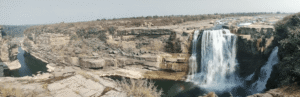
Enroute to Keoti falls, we saw another waterfall on google maps, Chachai. There we enjoyed more views of the Indian Vulture including its nesting sites in the escarpments. Keoti Fort was closed but the waterfall flowed. Later in the evening, Maihar temple had a two-hour wait, so we simply kept driving — satisfied that the real highlight of the day had already taken flight above us.
Day 9 — Marbles & Mist
Dec 28, 2025
Breakfast at a modest Wayside Restaurant in Katni set the tone for the day — hot, simple, unexpectedly good food. From there we drove toward Jabalpur, where the Narmada gathers momentum and drama. At Dhuandhar Falls the river did not flow — it detonated. Water crashed downward in thick white plumes, rising again as mist, giving the falls their smoky name. The viewing platforms were crowded, but the force of the river drowned out most distractions. A short climb to Chausath Yogini Temple offered symmetry and altitude — a circular shrine with quiet panoramic views, the kind of place that feels older than the concept of traffic below.
Later, we took a boat through the marble canyons of Marble Rocks. The cliffs rose sharply on both sides — pale, striated, and luminous under the winter sun — while the boatman delivered rhythmic commentary, half poetry, half stand-up routine. It was theatrical, but the geology did most of the work. Unfortunately, the Jabalpur fun curdled and weakened near the Bhadbhada watefalls, where loud music, plastic waste and enthusiastic dancing competed with the river’s dignity. It was a jarring contrast: sublime natural sculpture upstream, careless celebration downstream. We left with mixed impressions — awed by stone and water, mildly exhausted by people.
Day 10 — Highways & Pilgrims
Dec 29, 2025
The morning began inside the green quiet of Dumna Nature Reserve Park, where we went for a straightforward walk and unexpectedly walked into a birding jackpot. Red-naped ibis probed the ground methodically, grey hornbill flapped between trees with prehistoric confidence, plum-headed parakeets flashed pastel streaks overhead, and somewhere in the canopy a cuckoo-shrike refused to pose properly. It was one of those sessions where you stop saying “nice sighting” and start saying “what next?” Breakfast at India Coffee House felt well-earned — old-school interiors, efficient service, strong coffee restoring human focus after avian distraction.
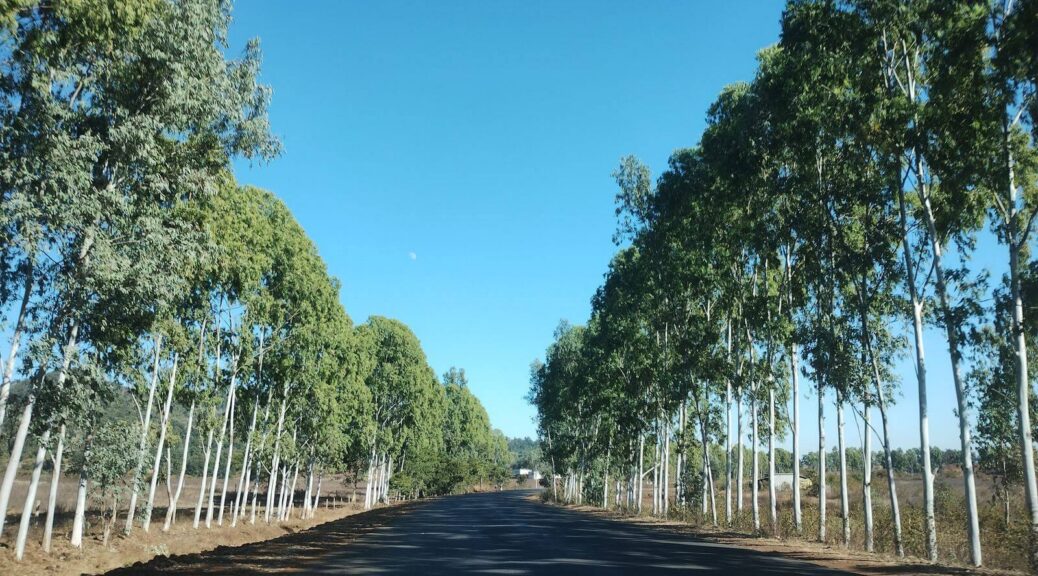
Once we left the city and merged onto the highway toward Amarkantak, the tone shifted from checklist birding to cinematic India. Pilgrims performing the Narmada Parikrama walked steadily along NH-45, large backpacks strapped tight with foam rolls for bedding, white dust-coated clothes, woollen caps, mismatched socks, cracked shoes. Some had beards growing wild; all had the steady rhythm of long-distance walkers. The late-December sun softened the otherwise cold wind across rolling hills, harvested fields stretching into pale gold, untended grass bending quietly. Tall eucalyptus trees lined portions of the road in such geometric formation that it felt like a frame from Gladiator — the poplar-lined path where Maximus walks through memory. It was that kind of light.
Midway through this reflective stretch, Shashwat suddenly asked
वो क्या है?
We pulled over — because that is now standard operating procedure — binoculars out, Merlin app consulted, mild argument initiated. Egyptian Vulture. Distinct shape, pale body, dark flight feathers. Another raptor added to the growing list, and another reminder that this trip was stealthily turning into a birding expedition.
Just before Amarkantak, we noticed tall Saj trees (also called Asna)— elegant, different from Sal despite popular opinion insisting otherwise. I spent an unreasonable amount of time cross-checking identification, mildly vindicated when confirmation aligned with instinct. Evening at the Narmada Temple was calm, but accommodation plans were not; with no booking available, we improvised and drove onward to Pedhra, ending the day somewhere between pilgrimage town and highway uncertainty.
Day 11 — Mainpat: Coal Dust, Caves and Elastic Earth
Dec 30, 2025
The road to Mainpat began with a fox crossing casually ahead of us, as if verifying our entry into Chhattisgarh’s quieter interior. Not long after, the landscape darkened near the Raniatari coal belt — endless trucks, fine black dust settling over trees and roadside tea stalls, the highway looking as though it had been shaded in pencil. The Hasdeo River appeared briefly beside us, wide and unbothered, holding its own calm despite the industrial backdrop. Hunger dictated our next stop: a small, unnamed roadside eatery in a village that would never trend online. Egg curry, hot rotis, metal plates, no menu theatrics — exactly what the day required.
Mainpat itself unfolded as a plateau of surprising variety. At Kendai Waterfall, water dropped cleanly into a rocky basin, framed by forest that felt properly removed from city tempo. The nearby Sitabengra Caves and Jogimara Caves carried faint historical whispers, their weathered surfaces holding stories that predate current borders. Saj trees reappeared in dignified clusters, tall and straight, as if deliberately reclaiming the hillside. At Thinthini Patthar we tested the famous hollow rock — striking it lightly and hearing a metallic clang ring out improbably from stone. And then came Jaljali, the “bouncy” swamp — ground that yielded underfoot like a reluctant mattress, a strange elastic sensation that made us laugh like children testing physics.
Evening softened into a quiet visit to the local Buddha Temple, followed by steaming bowls of thukpa at a Tibetan eatery — a reminder that Mainpat carries its own layered cultural identity. Coal trucks, waterfalls, caves, Tibetan soup, and springy earth — the day refused to be categorized.
Day 12 — Remote Roads of Chattisgarh
Dec 31, 2025
Morning in Mainpat began with a visit to the local Tibetan monastery, prayer flags shifting gently in the cold air while chants drifted softly from within. It was calm, composed — a contrast to what the road ahead had planned. We stopped briefly at Tiger Point, more viewpoint than wilderness encounter, before descending into increasingly narrow ghat roads toward Nakiya waterfall. The jungle thickened, mobile signals weakened, and the road turned steep and stubborn. This was perhaps the most remote stretch of Chhattisgarh we would manage on this trip — dense forest, sparse settlements, and the occasional local man walking with an axe slung casually over the shoulder, lungi wrapped both below and sometimes across the torso against the chill. It felt raw, unscripted.
Dev Pahari waterfall required patience and faith in directions, but rewarded us with solitude. By late afternoon we rolled into Korba, dusty and properly hungry. The redemption came plated generously at Kaake Di Hatti — sarson ka saag and makke ki roti that could repair both morale and metabolism. After days of highways, forests and uncertain food stops, this felt like culinary affirmation. The year was ending not with fireworks, but with mustard greens and corn bread — and honestly, that felt correct.
Day 13 — The capital, Raipur
Jan 1, 2026
The first morning of the year began on the road to Raipur, but not before one more unscheduled halt near Jhika Hasdeo Point. A black-winged kite hovered in textbook stillness over open fields — white body, sharp black shoulder patches — then dropped vertically in a clean hunting dive. Indian rollers flashed electric blue from roadside wires, and at one point a large crane-like bird crossed high above us, triggering the now-familiar in-car dialogue: “What’s that?” followed by an immediate pull-over and binocular deployment. This trip, which was never marketed as birding-heavy, had clearly made its decision. The previous one had been planned around birds; this one was ambushing us with them.
We paused at Vishnu Temple, Janjgir — quiet, proportioned, almost empty — before merging onto the expansive, almost futuristic roads of Nava Raipur. The sudden width of highways and urban planning felt surreal after days of forests and ghat roads. Our arrival at Mayfair Lake Resort amplified that contrast further: manicured lawns, reflective waters, deliberate symmetry. After so much dust and unpredictability, the hotel felt almost indulgent. We took an evening walk around the property, letting the still lake absorb the fading light, and closed the first day of the year with dinner at the in-house Italian restaurant — a far cry from roadside egg curry, but somehow part of the same continuous journey.
Day 14 — Flycatchers, Dams and Free Bird Tourism
Jan 2, 2026
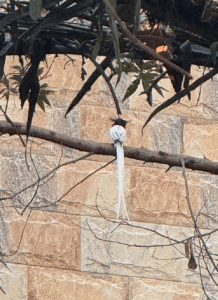
Morning at Mayfair Lake Resort began as a relaxed lakeside walk that quickly escalated into fieldwork. While an inquisitive aunty stopped us to ask the standard travel questionnaire — “Where are you from? How long?” — Shashwat handled the social diplomacy and I instinctively scanned the trees. A flash of white flickered through the branches like a ribbon caught in wind.
Flycatcher!
I blurted mid-conversation. Binoculars confirmed it: an Indian Paradise Flycatcher, white morph, impossibly elegant, tail streaming like punctuation in motion. Of all places to find it — manicured hotel grounds on New Year’s morning.
We left reluctantly, heading toward the Chhattisgarh–Maharashtra border and stopping near the backwaters around Sirpur Dam and Chabuknaka. The setting was immediately appealing — quiet water, open grass, scattered trees, the kind of place that invites you to stay longer than intended. While we unpacked lunch, a deep, familiar call drifted across the field. A quick check on eBird suggested red-naped ibis, and moments later we were staring at three or four of them walking calmly just 20–30 meters away. As if that weren’t generous enough, two black-headed ibis perched nearby in the trees, unbothered by our astonishment. It felt like curated bird tourism, except there were no guides, no jeeps, no fees — just us, our food, and a front-row seat.
We drove another dam road in the evening, partly for exploration and partly because the day had trained us to expect surprises. By now the pattern was undeniable: every unplanned stop carried the potential for wings.
Day 15 — Backwaters and the Road to Lonar
Jan 3, 2026
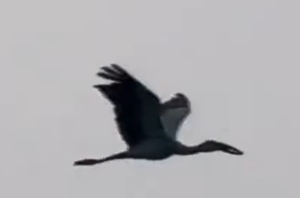
By now, stopping for birds had become muscle memory. Morning drew us again toward the backwaters near the dam, where red-naped and black-headed ibis were already at work in the shallows, probing with calm determination. An Asian openbill cruised overhead, sandpipers stitched nervous lines along the water’s edge, and a common kingfisher flashed blue before vanishing into reeds. It was methodical, satisfying birding — the kind where each sighting builds quietly on the last.
Then came the unsolved mystery. A bird of prey perched high on a distant tree caught our attention — silhouette strong, posture confident, details frustratingly unclear. We tried everything: binocular angles, phone zoom, eBird filters, speculative Googling, even Moyanak-style elimination logic. Nothing felt definitive. For once, the bird won. It remained unnamed, adding a small, stubborn footnote to the trip.
Later, driving past the forested stretch near Navegaon National Park, we spotted another raptor — this one large, dark, and hovering with slow, deliberate wingbeats above the treeline. We pulled over immediately. Through binoculars it appeared almost entirely black, broad-winged, commanding. eBird tentatively suggested Black Eagle, and for a few minutes we allowed ourselves to believe it. But distance and light refused to cooperate, and we drove on with another inconclusive entry — plausible, exciting, unconfirmed.
On the approach to Lonar, we stopped near Mehkar where agile birds skimmed low over backwaters, later identified as river terns. Two grey hornbills flapped across the road near our hotel as if casually marking territory. The day did not offer monuments or waterfalls; it offered uncertainty, debate, and the quiet thrill of chasing names through the sky.
Day 16 — Green Water, Temple Ruins and the Long Way Home
Jan 4, 2026
Morning at Lonar began, predictably, with birds. Around the resort grounds, three or four plum-headed parakeets moved restlessly between treetops, their soft colours catching the early light. Somewhere in the scrub we could clearly hear the sharp, repetitive calls of grey francolin — the classic teetar soundtrack — but despite scanning patiently, the caller refused to materialize. A final small reminder that not every sound earns a sighting.
By late morning we descended into the crater of Lonar Lake, the meteor-formed basin holding its distinctly green water like an alien secret. The lake level seemed higher than before; part of the submerged temple near the edge was now partially swallowed by water, its stone pillars emerging directly from the green surface. The trek down was steady and dusty, the climb back up humbling. We rested near the temple ruins, where a grey hornbill passed overhead and a rufous treepie hopped between branches, inspecting us with theatrical curiosity. Even at the supposed end of the journey, the birding refused to clock out.
We left around 5:30 PM, the long highway pulling us back toward Mumbai. By 11 PM we were in Thane, eating a slightly triumphant dinner at McDonald’s — the most unceremonious finale possible after forests, falls and fossilized craters. Midnight found us home, dusty bags unpacked, memory cards full, and a growing suspicion confirmed: this “Central India safari” had quietly become one of our most bird-heavy road trips yet — entirely unplanned, entirely perfect.
Epilogue — The Dividend of Wandering
Somewhere between a cancelled flight in Mumbai and a green crater lake in Lonar, the original purpose of this trip quietly dissolved. It was never really about covering destinations efficiently, or ranking waterfalls, or even optimizing temple circuits. The real reward emerged in the empty stretches — the coal-dusted highways of Chhattisgarh, the sal forests near Panna where sunlight filtered through tall, disciplined trunks, the quiet backwaters near state borders where ibis fed unconcerned by human ambition. None of those places had curated entry gates or dramatic Instagram signage. Most did not even have reliable mobile networks. Yet they offered something megacities and polished itineraries rarely do: unmanufactured surprise.
Five-star hotels like Mayfair Lake Resort are comfortable — manicured lawns, symmetrical reflections, controlled lighting. They restore the body. But it was the unplanned roadside halts that restored something subtler. A vulture circling unexpectedly over Chachai. An Egyptian Vulture confirmed mid-highway debate. A paradise flycatcher interrupting small talk. A large, dark raptor near Navegaon National Park that we may never conclusively name. These moments demanded nothing except attention. No tickets, no curated storytelling, no crowd choreography — just two people willing to pull over because something moved in the sky.
Crowded megacities impress with scale; remote Central India humbles with stillness. In cities, experiences are scheduled. On these roads, they are earned accidentally. You drive without certainty, you stop without reason, you wait without guarantee — and then, occasionally, the landscape rewards you with something precise and fleeting. That exchange feels honest.
In the end, the fruits of senseless wandering were not dramatic. They were cumulative. A growing list of birds. A better instinct for forests. A deeper comfort with long roads that promise nothing. And the quiet understanding that the richest parts of travel often lie between the marked points on a map — in the pauses, in the detours, in the decision to stop the car because someone said, “Wait… what’s that flying?”
Route
Kanpur to Amarkantak
Amarkantak to Mumbai
Numbers
- Distance Traveled: 3000+ km
- Cost: ₹ ~50k